Become a Friend of the Swindon Museumand Art Gallery

For only £15 a year, you can become a Friend and receive information about our talks. To become a Friend or find out more about us, go to the website www.friendsofmas.org
Showing posts with label Swindon. Show all posts

Tuesday, 24 May 2022

Swindon's Mammoth Graveyard

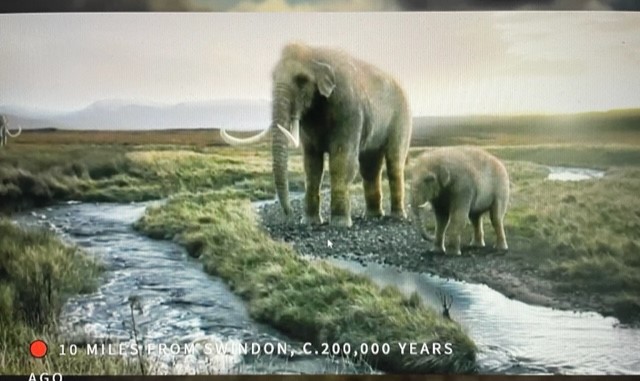
 Towards the end of 2021, news began to emerge of mammoth bones being discovered by Sally and Neville Hollingworth in a quarry north of Swindon. The finds were so significant that they passed the management of the discoveries onto Dig Ventures, an archaeological organisation based at Barnard Castle who have the capability to manage finds. We were very pleased when Maiya, Lisa and Ginny from Dig Ventures agreed to give our April Zoom talk on the Swindon mammoths.

We're looking back 200,000 years ago, this discovery is the most important in a generation apparently. I loved the reconstructions of what the mammoths might have looked like, although it is not known if neanderthals coexisted with the mammoths.
The quarry was no longer in use when Sally and Neville came across many Jurassic fossils such as crinoids and ammonites. It was when they found a large mammoth tusk on the ground that they realised there might be some very interesting finds. It's such a large site, the question was where to start? Two years were spent making bore holes and examining their contents. 3D photography of the site was used, and a small excavation made by Historic England. The finds are from a time a hundred to two hundred times older than the Bronze Age and the finds such as hand axes and bones are so well preserved because apparently having been buried, they weren't moved. 
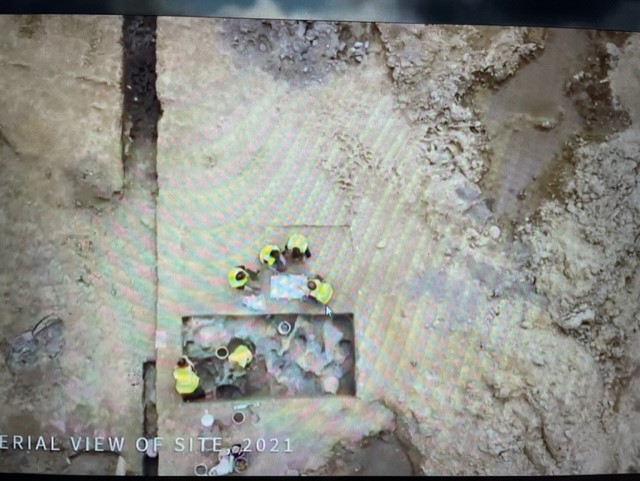
Above is an aerial view of the site, and below filming on site with Sir David Attenborough for a BBC film outlining the finds and their importance.
I think this photograph shows Sir David Attenborough with Sally and Neville when he first saw some of the mammoth bones.
Here's another aerial view
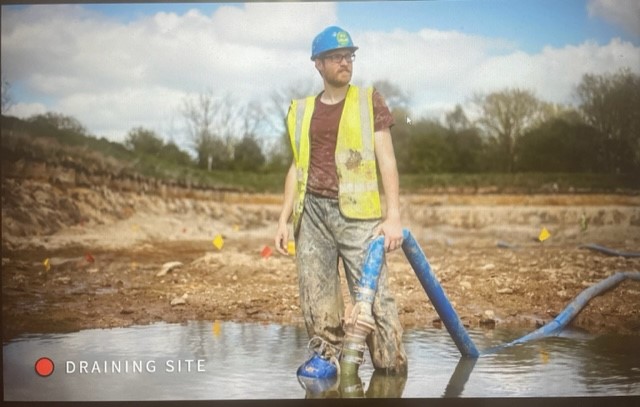
And a very important part of the process, draining the site which is 5 metres below ground level
You can see how well this mammoth tooth has been preserved, it looks a bit like a cheese grater
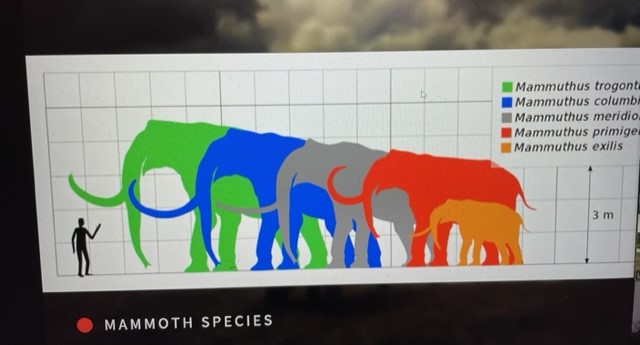
This slide gives an idea of the 5 different sizes of mammoths 
Here's Sally with a hand axe
This is a great slide showing some of the discoveries. Apparently the curvature of the tusk gives an indication of whether the mammoth was a male or female, and the number of rings, the age.
There are three more years of excavation still to be done at the site, and lots of questions to try and answer, why did the mammoths go to the area? Why did they die there? What other species were there at the same time? 
We are very grateful to Dig Ventures for coming along to tell us more about this fascinating find so close to home, if this has whetted your appetite, please go to Dig Ventures website where you can find out more about how to join in with an archaeological dig, or help fund one. The nearest might be at Sudeley Castle.
You will be pleased to know we gave Dig Ventures a donation towards their work, and look forward to finding out where we can see the mammoth bones being displayed.


Monday, 2 August 2021

Book Launch of Pevsner Architectural Guide to Wiltshire

In June, I was invited to a book launch of the revised edition of the Pevsner guide to Wiltshire, I sent the invitation on to the Friends' membership, and signed up to the talk which was advertised like this:

 'Our latest revised volume, Julian Orbach's Wiltshire, will be published on 8 June, and we are delighted to be holding an online event to launch the book. On Tuesday 15 June, at 6pm, the author will be live in conversation with the book's editor, Charles O'Brien about his survey of the county, and they will be joined by James O. Davies, photographer. There will be an opportunity to ask questions at the end'.

 I will include the introductory slide from the talk, but after that, we were told we couldn't take any photographs, so I have included one of my own.

The indispensable guide to the architectural heritage of Wiltshire

With hundreds of buildings added to the new gazetteer, this volume offers a fully revised and updated guide to Wiltshire. From prehistoric Stonehenge and thirteenth-century Salisbury Cathedral, to Elizabethan Longleat, Palladian Wilton and landscaped gardens of Stourhead, the buildings of Wiltshire represent the best of every period of English architecture. Towns range from Marlborough with its sweeping High Street to Bradford-on-Avon, rich in the architectural legacy of clothiers’ houses. Villages include the exceptional Lacock in the shadow of its abbey’s remains as well as Avebury, where the houses sit within the famous stone circle. This volume, covering structures as diverse as garden follies and railway workers’ housing is an essential reference for visitors and residents alike.

The talk was fascinating and has opened a door on how we might look at a place, in this case Wiltshire, and more particularly Swindon where I live. The Wiltshire Pevsner book was originally published in 1963, dedicated to Nicholas and Paul, and describes Wiltshire as 'the county of the cottage'. Wikipedia says this:

'The Pevsner Architectural Guides are a series of guide books to the architecture of Great Britain and Ireland. Begun in the 1940s by the art historian Sir Nikolaus Pevsner, the 46 volumes of the original Buildings of England series were published between 1951 and 1974. The series was then extended to Scotland, Wales and Ireland in the late 1970s'.

 The lecture was given by Julian Orbach and Charles O'Brien as it says above. I was particularly interested in what they said about Swindon, describing it as a 'wonderfully fascinating place' The David Murray John Tower he described as 'the best tower block of its period' and Wat Tyler house 'cheeky naming of council offices'. He commented that things change so fast in Swindon, in 1998, Motorola's huge pipe got a special mention, as did the former Renault building in Westlea described beautifully on page 711 of the guide as 'The cathedral among Swindon's giant sheds, designed to store automotive parts, but disused for twenty years'. A bit further on 'It remains a beautiful expression of architecture and engineering in harmony.'

After the main part of the lecture, James O Davies who has taken the majority of the photographs talked to us about the way he manages to achieve his fantastic photos. Some of you will remember we were fortunate enough to hear about his photography in a lecture in December 2020, you can read about it here. It wasn't videoed, but was memorable. James said when taking photographs for the guide, he likes straight on views, uses tall ladders, needs to absence of cars, people and garden furniture to achieve a timeless effect.James will persevere to get exactly the effect he wants, enjoys problem solving and will use lighting to help in darker corners and under trees. For obvious reasons, I can't reproduce his photographs here, but I will say that one of the most fabulous of his photos was Oare House Pavilion taken at 10.45pm on Midsummer's eve. The building, designed by I.M.Pei of New York, 2000-4, for Sir Henry and Lady Kewick is a 'pagoda of glass' in the grounds of Oare House, and described by me here.

I didn't take my photograph late at night, but will include it here so you can see the site and magnificence of the building:

I'm very pleased with my Pevsner guide, and would encourage you all to go out and buy one.

And to click here and sign the petition to Save our Museum and Gallery:

http://www.change.org/SaveSwindonMuseumandArtGallery


Friday, 4 September 2020

Swindon Before the Railway - a talk by Nicola Cornick

 We gathered excitedly last Thursday around our computers for a Zoom talk by historian and author Nicola Cornick, fascinated to find out more about Swindon before the railway put it on the map as a destination between Bristol and London.I took copious notes, but not being a historian, I have only a hazy idea about what ages a medievalist might be interested in, it's between 6th-14th centuries. The map below dates from about 1804,  a mere 37 years before the railway came through this idyllic country town                                                                                                                                                                                               

It's interesting speculate on various places on the map, was the Direction Post the site of the current Magic Roundabout? And is the Small Pox House the site of the former Victoria Hospital? And the origin of the name Swindon, was it really Swine Down, or Suindune in The Domesday Book. The place where pigs were raised?
Nicola took us back to when Swindon was a Saxon village with farmers and craftspeople living here, 1000 years ago there were blacksmiths and cutlery was being made here. The Vikings were here in 878 and were defeated. After the Norman Conquest, the area was divided into five areas. The town on the hill, what is now known as Old Town has a road system based on a square, with a market square in front of the Corn Exchange which goes back to 1346.
Above you can see a photograph of High Street which looks very similar today
What are mostly missing are the Holyrood Church above and totally missing, the Lawn Mansion House which was demolished in 1952
The Bell was a pub for a long time, although apparently not as long as is claimed above the door, sadly no longer a pub
Swindon has a reputation for smuggling, with many passageways beneath Old Town supposedly used for this, the Moonraker's pub sign is a Wiltshire tradition, told here.
This photo shows the interior of Ashdown House where some of the finest Swindon stone, Purbeck limestone was used for flooring.
The Cotswold Games involved lots of sword fighting as can be seen here, and also standing on your head, riding horses and shooting . What a great advertisement for the games this is.
And so we come to the end of the illustrated talk, with the last slide depicting a country lane.

Despite William Morris's disparaging remarks made about Swindon in the 1885, describing Holy Rood Church as 'insignificant', there's plenty of evidence that Swindon was a thriving rural market town, with plenty of advantages such as stone, springs and excellent farm land around. With a little bit of searching, I found this excellent blog post written by Nicola giving far more interesting details than I managed to note down.

The video recording of the talk is ready now, please click : here it is.

I've also had a couple of extra pieces of information, firstly in answer to my question, which I feel silly about now, I asked where the mill was! A member of the Friends has supplied these two paintings:

They are both by Thomas Luckett Jefferies who was Richard Jefferies' uncle. He also owned the Mill, the bakers by the Locarno as well as the farm.

Nicola was asked on the night about whether Wadard became Goddard and says this:

I also looked into the question on the night as to whether the Goddard family were descended from Wadard, the knight who owned Swindon after the Norman Conquest. Although there is a branch of the Goddard family who do claim descent from Wadard, there isn’t actually a properly authenticated family tree that proves this!

There was also a question about the pest house, here's the location:

'We have just watched the recording of Nicola's talk, and we noticed the question about where the pest house was.  The pest house is marked on the 1873 OS 25 inch map of Swindon.  The National Library of Scotland has digitised old OS maps and overlaid them on a modern satellite view.

The link below should take you to the page (you may have to get rid of an instruction sheet first by pressing X at its top right).  On the map page, you should see the pest house roughly in the centre, and there's a control panel on the left at the bottom of which is a transparency slider.  Use this to get rid of the old map and see where the pest house location is today - in the alleys between Goddard Avenue and The Mall.