Become a Friend of the Swindon Museumand Art Gallery

For only £15 a year, you can become a Friend and receive information about our talks. To become a Friend or find out more about us, go to the website www.friendsofmas.org
Showing posts with label Archaeology. Show all posts

Tuesday, 26 December 2023

Richard Osgood MBE Operation Nightingale

 We were incredibly fortunate to have Richard Osgood as our speaker in October via Zoom. He gave us many examples of the therapeutic role played by archaeology in the lives of ex service personnel. There's a good synopsis of Richard's career here

I took some photos of Richard's slides during the talks and there's an unedited recording of his talk which you can see if you click on that link. I'll write down a few of my notes for the record. 

Richard joined the MOD in 2004, and has been their senior archaeologist for over 10 years; he and his team look after 770 scheduled monuments including 10 world heritage sites. With veterans of conflicts in Afghanistan and Iraq in 2011, Richard realised that PTSD as a result of conflict was not considered when his father served in WW2, but the wounds are real despite being hidden. Operation Nightingale is the name given to the exercise.

Richard started by telling us about the archaeology of a Burrow Island in Portsmouth Harbour, also called Rat Island.

It looks very scenic from a distance
above you can just see the holes where the bodies were slotted into the ground
above and below some of the skeletons they found

There's a sign warning people that it's MOD land  below

The island is reached by a small causeway twice a day at low tide, and between 2-5 May 2017 the holes in eroded cliffs were examined in an operation known as Exercise Magwitch. The holes in the cliffs are burial sites where the bodies were stacked on each other, It is thought the skeletons are those of the up to 7000 prisoners held in ship hulks in Portsmouth Harbour between 1796- 1814. They could have been French identified by their naval buttons and French graffiti and were maybe prisoners of war, mostly they were male. It's fascinating to see how a face can be built from the skeleton as suggested below:


In May this year, I first caught up with Richard Osgood who was leading an excavation at a football field in Aldbourne which is where the Band of Brothers were stationed during WW2. Richard was involved in the first one of these in 2019 at documented by Wiltshire Museum. Crisp packets and silk stockings are among artefacts found at the site, there are also memorable dog tags from two members of Easy Company, Richard A Blake and Carl Fenstermaker. There is a youtube video about this which you can access by clicking on the links on this X post, I hope.


Below is an example of artefacts found in Aldbourne:
On Salisbury Plain in 2012-14 Operation Nightingale excavated 100 burials of men and women many of which are at Devizes Museum now. DNA has been examined to find out if they are related. 7th Century decorative grave goods have been discovered and a Bronze age pin 2700 years old, seen in an archaeologists hand below

Below is a reconstruction of a bronze Age hut
and here's a 6th Century bucket made of yew, currently in Devizes Museum
Getting together outside doing archaeology is a great way of making friends

I'll finish with a plug for Richard Osgood' book: 'Broken Pots Mending Lives: the Archaeology of Operation Nightingale.
At least I thought that was the end of the post, but after writing it, I went to watch Digging for Britain with Alice Roberts who was looking at WW11 artefacts, and towards the end of the programme, there's Richard Osgood talking about the Aldbourne site and the importance of it at the end of the war when Easy Company were stationed there for 6 months leaving behind a wealth of interesting artefacts, Here's the link to the programme, and here are some photos taken from the tv:


The final one is with Richard Osgood and Alice Roberts.


Wednesday, 28 December 2022

November talk

Our November talk was to have been given by Richard Osgood, but he has had to reschedule and is coming to talk on 25 October 2023. Angela Atkinson, FSMAG committee member looking after our website content wrote this about Richard:

'Back in 2019, Richard Osgood won the Current Archaelogy Live’s, Archaeologist of the Year award.

Richard is the co-founder of Operation Nightingale – that’s an initiative that uses archaeological fieldwork to aid recovery of wounded veterans.

‘Operation Nightingale is a military initiative developed to use archaeology as a means of aiding the recovery of service personnel injured in recent conflict, particularly in Afghanistan. 

The huge range of sites on Salisbury Plain, many of them remarkably well-preserved within the Ministry of Defence training area, has provided an ideal opportunity for Operation Nightingale to engage in archaeology.

For over two decades Wessex Archaeology has been helping the Defence Infrastructure Organisation and its predecessors protect sites on Salisbury Plain, excavating and recording them where necessary, for example in advance of construction of new hard tracks which allow modern tanks and heavy equipment to be transported across the Plain …’

We look forward to his talk next year very much, meanwhile we have been given permission to use this photo of Richard with Prof Alice Roberts:


We will be releasing details of our whole 2023 Pearl Anniversary talks programme in the New Year

Tuesday, 24 May 2022

Swindon's Mammoth Graveyard

 Towards the end of 2021, news began to emerge of mammoth bones being discovered by Sally and Neville Hollingworth in a quarry north of Swindon. The finds were so significant that they passed the management of the discoveries onto Dig Ventures, an archaeological organisation based at Barnard Castle who have the capability to manage finds. We were very pleased when Maiya, Lisa and Ginny from Dig Ventures agreed to give our April Zoom talk on the Swindon mammoths.

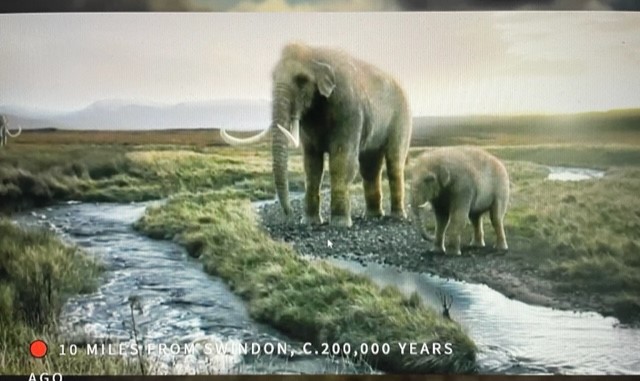
We're looking back 200,000 years ago, this discovery is the most important in a generation apparently. I loved the reconstructions of what the mammoths might have looked like, although it is not known if neanderthals coexisted with the mammoths.
The quarry was no longer in use when Sally and Neville came across many Jurassic fossils such as crinoids and ammonites. It was when they found a large mammoth tusk on the ground that they realised there might be some very interesting finds. It's such a large site, the question was where to start? Two years were spent making bore holes and examining their contents. 3D photography of the site was used, and a small excavation made by Historic England. The finds are from a time a hundred to two hundred times older than the Bronze Age and the finds such as hand axes and bones are so well preserved because apparently having been buried, they weren't moved. 
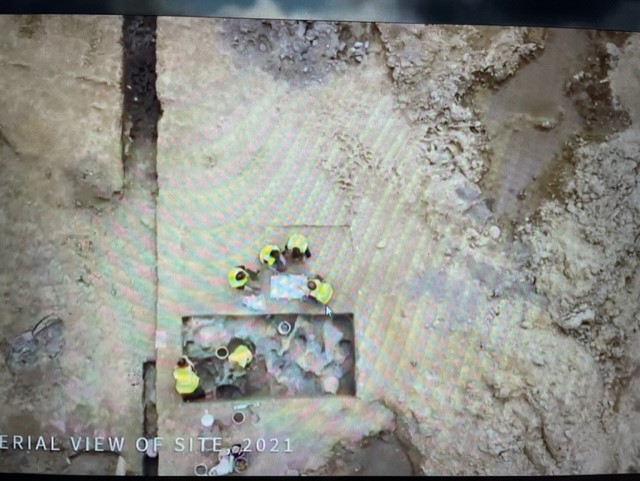
Above is an aerial view of the site, and below filming on site with Sir David Attenborough for a BBC film outlining the finds and their importance.
I think this photograph shows Sir David Attenborough with Sally and Neville when he first saw some of the mammoth bones.
Here's another aerial view
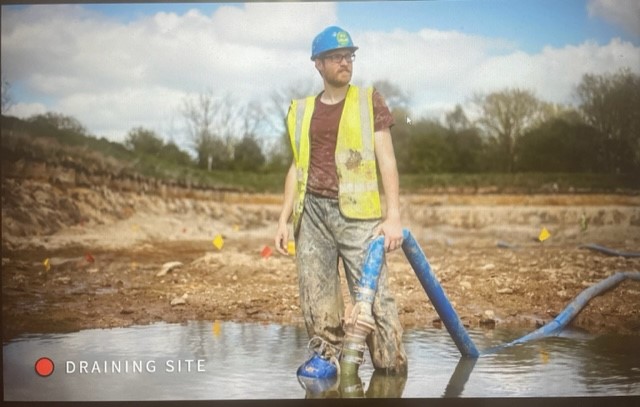
And a very important part of the process, draining the site which is 5 metres below ground level
You can see how well this mammoth tooth has been preserved, it looks a bit like a cheese grater
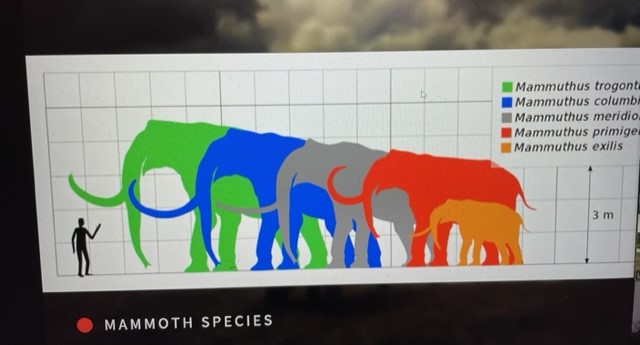
This slide gives an idea of the 5 different sizes of mammoths 
Here's Sally with a hand axe
This is a great slide showing some of the discoveries. Apparently the curvature of the tusk gives an indication of whether the mammoth was a male or female, and the number of rings, the age.
There are three more years of excavation still to be done at the site, and lots of questions to try and answer, why did the mammoths go to the area? Why did they die there? What other species were there at the same time? 
We are very grateful to Dig Ventures for coming along to tell us more about this fascinating find so close to home, if this has whetted your appetite, please go to Dig Ventures website where you can find out more about how to join in with an archaeological dig, or help fund one. The nearest might be at Sudeley Castle.
You will be pleased to know we gave Dig Ventures a donation towards their work, and look forward to finding out where we can see the mammoth bones being displayed.


Wednesday, 2 February 2022

Art and Archaeology by Neil Redfern

 For our January talk, we were given an illustrated talk by Neil Redfern, Executive Director of The Council for British Archaeology who gave us a fantastic insight into his thoughts on archaeology. I can say that if I had heard that talk as a teenager, I would have taken an archaeology degree. In short he's the bees knees when it comes to how an archaeologist looks at the world.

Neil started by explaining that archaeology is not about preserving finds in an archive, but thinking creatively about heritage. He has worked for Historic England, based in York for over 20 years. The photographs above taken from my computer screen show their remit includes pre historic sites, monastic sites, ruins, national parks, 1960s flats in Sheffield that are Grade 2* listed.
The next slide showed the uniform an inspector for English Heritage, the forerunner of Historic England looked like in 1913. One of the things hotly contested at one time was the notion that trees were bad for archaeological sites, and above you can see a bronze age barrow with trees on it. Now trees are left where they are growing, because thye are seen as part of the landscape.
Above are some words associated with archaeology and explaining what it encompasses.
Above is a slide showing 3 views of Whitby Abbey, this has been subject to 'gatekeeping', a process where the site is 'tidied up' from the original condition it might have been in at the turn of the last century, surfaces evened out and grass laid and mown so visitors can easily walk round without tripping up.
Other examples of this process include Berkhamstead Mott and Bailey Castle where the moat was enhanced by resculpting in the 1920/30s, and trees were removed. Helmsley Castle also has had sculpted earthworks. Sandal Castle is perhaps the most fascinating example of changes made to ruins. The old print shows three windows and Wakefield in the background, which it isn't quite, and present day photos show one of the windows has been filled in, presumably to give the structure strength? The site has also been excavated and sculpted making it stark and sterile.
Neil talked about many sites being at risk from arable cultivation, and then talked about not preserving, but creating from archaeological sites. At Hanging Grimstone dig, medieval rooftiles were found that had been on a dovecote, after the dig, rather than than putting them back again after the dig was finished, they were used to paint on, the results are seen below.
And more here
I hadn't heard about the Lego lost at sea in 1997 which is now being washed up in Cornwall, but collecting the Lego is a lovely project 
Some recommended reading for us all..
Neil's reduced lexicon to include the words he feels essential to the archaeological process
Hatfield Colliery is an important landmark, and an example of how the art of loss can be used creatively via storytelling and finding what is important in a community. What they value. Being inquisitive, curious, storytelling and using creativity are essential to the process of archaeology. These notes have got a bit rambly, do watch the recording of the talk, apologies for my bit at the beginning, I don't have the necessary skills to edit recordings. 
Thank you for such a moving talk.


Tuesday, 28 September 2021

Archaeological Sites in and around Swindon

 Every Friend's talk we have been given has been written up as a blog post for the last 10 years, but lately I have got a bit behind with these, and with tomorrow's talk almost upon us, I thought I'd better catch up with writing up the July talk. We were very fortunate to have Melanie Pomeroy-Kellinger, archaeological adviser for Wiltshire and Swindon talking to us via Zoom. This is the information a yields:

 'Melanie Pomeroy-Kellinger is a professional archaeologist of more than 25 years’ experience. During that time she has carried out fieldwork, research and lecturing in Britain and overseas including  in America, Greece and North Korea. For the last 11 years she  has been managing the Archaeology Service at Wiltshire Council as County Archaeologist. A particular focus of her work over the last two decades has been the archaeology and conservation of the Stonehenge and Avebury World Heritage Site.' from A303 Scientific Committee.

 I will share my notes and photos from the computer, and fortunately we have a video of the talk where you can find out exactly what Melanie said.

Melanie focused on 8  or 9 sites around Swindon; there are approximately 1800 sites in the area, many around Wanborough and the A419 along Ermin St and in the south east along the M 4 corridor. The eastern villages developments will expose a lot more sites. The first site Melanie talked about was the Foxbridge development where a Roman town can be seen, maybe like the one mapped below.

Maps form an important part of recording remains, there's a site along the A 420 opposite the police station where significant remains have been found, the site is scheduled and will not be built on.
If you look up Marston Farm, there are archaeological reports on the importance of things like a Roman oven with burnt material inside it.
A third site, Sam's Lane, Blunsdon is the site of 32 cremations, some of them in pots. A fourth site of Roman development is at Roves Farm which was surveyed before a solar farm was built on the land.
Day House Lane dates back to early Iron Age. The highlighted link outlines the furore around developing the area, the development did go ahead, although the stone circle has not been built on.
Melanie also talked about artefacts like brooches found at these sites and described this area as the breadbasket of England which is why there are so many archaeological sites here, it was a pleasant place to live. Lots more excavations are needed to get a better picture.
If I had written this talk up before, people may have been able to go on this trip.
Apologies for taking so long to get this posted, and thank you Melanie Pomeroy-Kellinger for a super talk.