Become a Friend of the Swindon Museumand Art Gallery

For only £15 a year, you can become a Friend and receive information about our talks. To become a Friend or find out more about us, go to the website www.friendsofmas.org
Showing posts sorted by date for query Mark Golder. Sort by relevance Show all posts

Wednesday, 31 December 2025

May Talk by Mark Golder on Stephen Russ

 We were very pleased to welcome back Mark Golder who has given many excellent talks to the Friends in the past and supported us in many ways. This was a fascinating talk shining a light on Stephen Russ and the importance of book cover art. Here's the illustration used for the talk:

'The Illustrator, Stephen Russ'
by Mark Golder

Stephen Russ lived at Shaw Hill near Melksham and taught fabric design and then printmaking for thirty years at Bath Academy of Art (Corsham); but he is better known in the world of illustration as the designer of dust jackets for over eighty books between 1945 and 1975, and as the designer of covers for the Penguin Poetry series in the 1950s and 1960s. He also produced a generic cover for Penguin's D. H. Lawrence novels, and it was his design of a phoenix rising from the flames on the front cover of 'Lady Chatterley's Lover' when Penguin was taken to court for obscenity. This illustrated talk will concentrate on the dust jackets and cover illustrations, considering how they reveal the artist and the major concerns of the times in which he lived.
Here are some photos taken at the talk:


It's difficult to take good photos in the Council Chamber at the Civic Offices but I think you get a good feeling of the atmosphere by not cropping the photos.

Thursday, 20 February 2025

'Seriously ...' FMAS Choices and the Process

 I am really pleased to let you know about an exhibition opening on Tuesday 25 February, of works chosen by members of the Friends of Museum and Art Swindon which will be displayed in the small gallery where an exhibition of Wessex Landscapes was shown alongside the Hardy exhibition. Those involved will be giving a talk to the Friends on Thursday 24 April so I don't want to give away too much of the process by which items were selected, or talk too much about the works selected because it will be good for most of it to be a surprise. 

The first call outs via email went out to the Friends in August 2024 asking for volunteers to get involved in selecting artworks and ceramics from the collection. There were six of us initially involved and then this whittled down to a regular three of us meeting Katie Ackrill, Collections and Exhibitions Officer to suggest works and then vote on them. This was a fascinating process which went on seemingly for weeks as we kept meeting and trying to reach a consensus and respect differences in taste without getting too personal. We learnt a lot about the collections and to appreciate works we had never really looked at properly. 

A couple of weeks ago, we were invited by Katie for a day to help hang the exhibition, what a fabulous opportunity! Naturally I took a few photos to remind us of the day and share with others. I'll start with a serious shot of three of the main selectors: from the left Miles Franklin, Claire Parsons and me, Linda Kasmaty. Although Claire was wearing a gorgeous red coat, we decided that black and white looked good.


I'll now add a few of the hanging day photos:
Some paintings had the correct fixings for the hanging system, others didn't
Some of you will recognise Andrew Cross Chair of the Friends who joined us to help on the day
In the background you'll see John Wood, Collections and Exhibitions Manager, as well as Katie Ackrill
It was a real treat to be able to see the reverse side of paintings
Miles and Andrew in action
and looking at 'Monument'
This is the reverse side of the Bomberg
above more fitting fixing
Above one of my favourite ceramic pieces some of you may remember on display at Apsley House. It is made by Laurance Simon and one of 50 ceramics gifted by Mark Golder and Brian Thomson in 2015 in memory of Ron Sloman . There was much discussion about this piece.
It takes four people to hang a painting!!
Appreciating the work once it's on the wall
'Jerusalem' by David Bomberg was chosen by John Walsh, a long standing member of the Friends who played a large role in the committee at one time. The frame was really heavy.
We also described, said what we liked about 3 works on another day. Katie will edit what we have said down to 5minutes I think and it will appear on Bloomberg Connects. Also look out for descriptions of works by those who chose them which will appear beside the works, possibly.
More on this exhibition in the next blog post.


Tuesday, 14 January 2025

Talks 2025

 Talks are now being organised by Carl Gomez who is also managing the membership.

The list of talks for 2025 is almost complete., they will be held  at 7.30pm in the Council Chamber,  Full details of all talk will appear on the website when we have them.

Jan 30th - Dr Keith Parsons on The Glasgow Boys
The Glasgow Boys were a group of Scottish based artists who made a big splash in the art world of the 1880s with their challenge to the art establishment and adoption of the new “realistic” style. This talk will explore who they were, who they were influenced by, and their impact on Scottish art. The talk will be illustrated with examples of some of their works, together with their influences, put in the context of the art world of their time. We will finish with information on where you can see their works displayed today.
 

Dr Keith Parsons is a retired research scientist with an interest in both history and art. He currently serves as Secretary of Chiseldon Local History Group and is active in Swindon U3A.


The painting Is 'Pastures New' by James Guthrie

27th Feb - Mike Allen on the Cerne Abbas Giant

27th Mar - Ann Rachel Harwood on Antarctic Explorer Edward Adrian Wilson

24th Apr- Seriously ...- Miles Franklin and Claire Parsons

29th May - Mark Golder on the artist Stephen Russ

26th June - Michael Gray on the history of Tarot Card art

31st July - Gavin Jones on the art of Tattooing 

28th Aug - Kirsty Hartsiotis on Stained glass in the Arts and Craft movement

Sep 25th tbc

30th Oct tbc

27th Nov - Phillip Garrahan on Swindon Art in the Age of Steam 

Monday, 19 August 2024

The Shape of Things: Still Life in Britain

 The talk about the new exhibition at Pallant House Gallery: The Shape of Things: Still Life in Britain was due to be given by Chief Curator at the Pallant, Melanie Vandenbrouck at the end of May via Zoom, however, Zoom had changed their settings and I didn't realise I needed to give people attending a passcode, or tick the no passcode box, only a handful of people were able to join us via Zoom, so Melanie kindly agreed to give the talk at the end of June. Postponing the talk meant we had two talks in June which was rather nice. 

Melanie explained a bit about PHG about the 500 objects, the Kelly bequest. How Sandy Wilson and MJ Long also extended the collection in the early 2000s. In 2006, the Golder-Thompson gift included 550 prints, drawings and ceramics. Melanie paid tribute to the generosity of donors and reminded us that the permanent collection is housed in the old house and new wing. 

The temporary exhibition programme has 2 seasons per year April/May to October and then November to April.

Melanie then showed masses of slides of the exhibition; there 150 works by 100 artists, 40 of them living, in the exhibition including the one used for the poster, Bright Intervals by Edward Wadsworth seen below loaned by Museum & Art Swindon:

Museum & Art Swindon also loaned William Roberts painting: La nature mort

Melanie showed us many wonderful views of the exhibition rooms, themed as you will see below: Still Life as a genre was born in the 17th Century when migrant Dutch artists such as Simon Verelst and Edward Collier came to England. Mary Moser, one of the two female founders of the Royal Academy in 1768 was notable for her extraordinary skill in flower paintings, historical subjects and portraits. Here are examples of some of the first Still Life paintings by these artists:

and then there are some beautiful paintings below in this group of early twentieth century artists including Nina Hamnett, Vanessa Bell, Duncan Grant, George Lesley Hunter, JD Ferguson, Walter Sickert and Mark Gertler featured here but others in the exhibition representing the turn of the century

Post First World War is represented by the room titled Order, Reality and Dreams
 represented by Edward Wadsworth, David Jones and Howard Hodgkins.

Next Paths to Abstraction through the dissolution of objects into arrangements of volume, form and colour featuring work of Barbara Hepworth, Ben Nicholson, Wilhelmina Barns-Graham, Anwar Jalal Shemza, William Scott and Margaret Mellis
The next room, painted black reflects on the second world war and its aftermath
After the war and into the sixties, life changed reflected in the art produced by a new group of artists


There are some wonderful works in the Stillness and Reflection room.
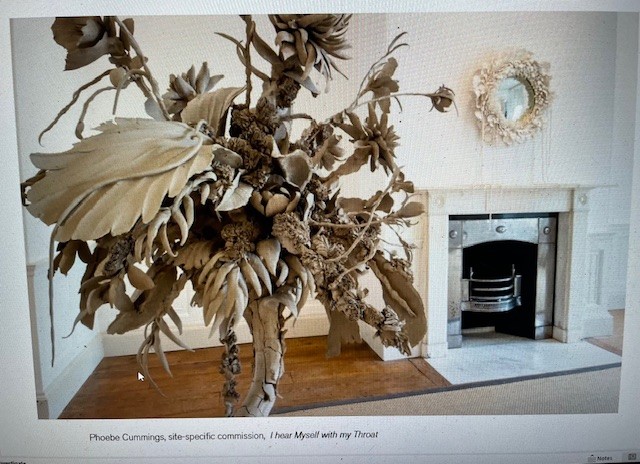
I've also included the Phoebe Cummings piece below; her exhibition of unfired clay structures will be on display until 20 October
and it looks like there's a wonderful exhibition of British Studio Ceramics in the Print Room

I'm Hoping to visit Pallant House Gallery this Thursday and really looking forward to seeing this amazing exhibition. So wonderful to have this insight into the exhibition.


Tuesday, 27 June 2023

May Talk: Chippenham Museum's Collection of Prints

 We were very pleased to welcome back Mark Golder to talk about his work with Chippenham Museum and the Golder-Thomson Gift of prints spanning the twentieth century to the museum. Many posts appear on this blog if you look up Mark Golder, this one for instance which gives some perspective on Mark, a far better insight into their philanthropy can be gained from the Pallant House Gallery website.

Mark began by comparing the populations of Swindon and Chippenham to give an idea of the size of the place. Swindon's population is 222,000 and Chippenham's 36,000. Chippenham has a small museum and has now been given room to expand, it is run by 4 staff and volunteers. Sarah Purvey, Calne based ceramicist played a significant part in developing the modern and contemporary art collection, introduced Mark and his partner Brian to Chippenham Museum. Two books have been produced with works acquired with a forward by Jo Baring Director of the Ingram Collection who talks about 'the visionary work being done at Chippenham Museum' The books are £5 each and when you visit Chippenham Museum, well worth buying.

Mark and Brian also produced a book entitled 'A Century in Print 1920-2020 The Golder-Thompson Gift'. The gift is in memory of Arthur Norman, manager of the Sue Ryder shop in Chippenham before moving to Eastern Europe. The collection is in 3 parts, designed to look at Wiltshire printmaking, there were 3 exhibitions showcasing works in the three eras. There were 60 prints donated in all, part funded by the local arts society; 16 from 1920-30, 25 from the 1940-80s and 19 from 2000-2020.

Robin Tanner etcher and educationalist was a teacher, loved Chippenham; his etchings give vivid evocations of life a hundred years ago. His Harvest Festival, Wiltshire Roadmaker and Gamekeeper's Cottage etchings are great examples of his work. Below the Roadmaker who has one of the most back breaking jobs. 

Moving onto the 1940s many of the artists in this section attended Bath Academy of Art at Corsham Court moved from Bath during the second world war.
Rosemary and Clifford Ellis attended and created poster like the one below of Teignmouth for Lyons tearooms

Few women got involved at Corsham Court, although Gillian Ayres produced silk squares, one in this collection and the other is in the Tate Collection. 
In the third section bringing us up to the present day, there are many names becoming more and more recognised. I visited this exhibition and took a photos of these works:
Above and below works by Sarah Purvey, particularly love the ceramic piece above, Friends bought one several years ago for the SC.

Above a commission by Jo Taylor for ITV
Above a mezzotint engraving of a Peppered Moth by Sarah Gillespie RWA
Above Emma Stibbon RA Night Sea Ice
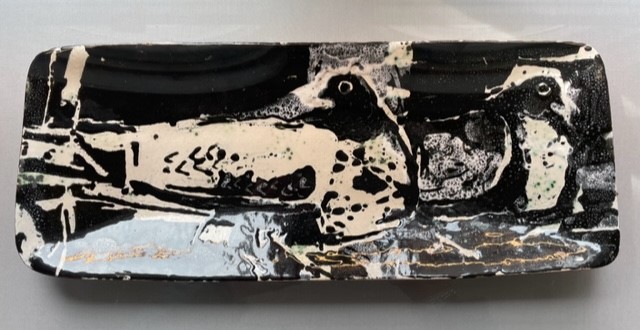
Above Celia Cook, Variant 22 a woodcut, and finally the piece below is a new acquisition at Chippenham Museum, it's 'Large Platter with Doves' by James Tower, purchased with support from ACE/ V&A Purchase Grant Fund and Art Fund.
Thank you once again Mark for the inspirational talk, and do please visit Chippenham Museum.


Sunday, 5 February 2023

Talks for 2023

 I'm pleased to say we have almost booked our speakers for this years talks' programme, with thanks to all those who have agreed to share their knowledge and expertise with us via Zoom.

We have had our January talk on Pictish Stones given by our deputy chair, Dr Barbara Swann. A video of this talk will appear on our website soon. You will find quite a few videos of our talks on the website, although not everyone agrees to be videoed for a variety of reasons.

These are the rest of the talks planned for this year, more details about each talk will appear on our website:

22 Feb The Making of the Museum of Making with Eilish Clohessy-Dennis, below is a photo of the Silk Mill in Derby where the Museum of Making is housed.

29 March British Heritage in Antarctica with Camilla Johns

26 April Architecture of Lydiard House with Michael Gray

24 May Chippenham Museum Collection of Prints with Mark Golder

28 June The Ken Stradling Collection with Cleo Saunders

26 July Ideally a talk about Sonia Boyce's work tbc

23 August 40 years as an artist with Anne Desmet

27 September St Barbe Museum women artist's ex with Dr Gill Clarke

25 October Operation Nightingale with Richard Osgood

29 November The Modern Story of an Ancient Monument; Stonehenge with Dr Susan Greanery

6 December Christmas meal

We are planning to run some trips, details coming soon via email. 

Thursday, 2 August 2018

Mike Yates talk on the Role of Ceramics Collectors

Mike Yates recently curated a ceramics' exhibition at Swindon Museum and Art Gallery, kindly loaning many of the ceramics in his personal collection to the show. The result was a fascinating collection of ceramics which got first place in Ceramic Review's top shows list, and attracted many visitors to come and look at it. The museum's curator Sophie Cummings kindly agreed for the exhibition to remain in place for another two weeks to enable us to ask Mike to give a talk about it, which he kindly did last week despite almost losing his voice.
The talk covered some major collectors, Mike's experience of collecting and his knowledge of ceramicists and how museums have acquired ceramics collections. I took a few photos which I'll add here, and then below the photos are some handy notes giving details of the talk.
 Above Slide of Bernard Leach pot with iconic 'leaping salmon' decoration, and below Mike Yates with a table behind him laden with more ceramics from home.

 Above slide of William 'Bill' Ismay and a small part of his collection, and below Slide of cutting from 'The Times'. Lucy Rie and Hans Coper pots from the Alan & Pat Firth collection.
 Unfortunately this slide hasn't come out very well at all, but this almost shows Mike holding an African pot from the Nupe people of central Nigeria, two things to note, the pot has a round base and so had to be placed in sand to be upright, and also the casual way in which Mike was holding it with one hand!!
The next pot seen below is a Janet Leach pot, the only justification for including another very dark photo, is to compare the shapes of the two pots, and you can see similarities from their silhouettes
Below Mike is holding an Ian Auld pot
 Below a slide showing Peter & Margaret Thomas' studio, Tweedmouth, north Northumberland. I've included this because anyone in the audience I'm sure would want to visit this studio.
 Mike brought two of the Thomas' jugs with him, the one seen below tells part of a story of Mike and his wife Emma's life on the jug.
I really enjoyed Mike's superb talk, and know lots of the audience did and would love some notes on people he was talking about, so here are some useful notes:

Mike began by outlining the lives of three ceramics collectors, Eric Milner-White, Dr John Shakeshaft and William 'Bill' Ismay. Milner-White, a cleric, bought his first ceramic piece in 1925. His collection contained important works by William Staite Murray, Bernard Leach and Shoji Hamada, the Japanese potter who had helped Leach set up the Leach Pottery in St Ives.  When he died Milner-White was Dean of York Minster and he left his collection of some 350 pots to York City Art Gallery. John Shakeshaft was an astrophysicist at Cambridge University who began collecting ceramics in the early 1970's. He left his collection to the Fitzwilliam Museum, Cambridge. William 'Bill' Ismay, a Wakefield Librarian, was possibly the most important collector of 20th century British studio pottery. He knew, and visited, countless potters in their studios and built up a collection of some 3, 600 pieces from over 500 potters, which he kept in his small two-up, two-down terraced house. Bill died in 2001 and his collection went to the Yorkshire Museum, near York.
Shortly after Bill Ismay died, it was decided that his collection should join the Milner-White collection and funds were raised to form the Centre of Ceramic Art (CoCA) in York, which opened in 2016. Anthony Shaw, a London-based collector gave over 800 items from his collection 'on permanent loan' and these pieces formed one of CoCA's opening exhibitions. Another early exhibition was of ceramics which had been decorated by Pablo Picasso. This collection, some 100 items, had been formed by Richard Attenborough and his wife, who would visit Picasso during their annual holidays in the south of France.
Mike pointed out that many people believe that collecting is a male only obsession, but Lady Attenborough had been actively involved in building this collection. Ann Carr was another collector who knew the potter Michael Cardew - she allowed Cardew to use her house on the Greek island of Naxos when he wanted to write his autobiography - and she bought many of his later works. These were left to Aberystwyth University who already had a large collection of Cardew's earlier work.
The Swindon collection had also benefited from the generosity of two ceramic collectors, Mark Golder and Brian Thompson, who have donated a large collection of contemporary pieces to the Museum - a wonderful gesture.
Mike then mentioned two important private collections which, sadly, were not left to public institutions. The first had been formed by Mike O'Connor, Head of Art at Christ's Hospital School, in West Sussex, the second by Alan and Pat Firth. The Firths' began collecting in the mid 1960's, firstly buying a work by Hans Coper, which they found in a Stratford-upon-Avon craft shop. They had spent £27,000 on their collection, which sold at auction for just under one million ponds.
Ian Auld, one-time Head of Ceramics at Camberwell School of Art, Ian's partner the ceramic artist Gillian Lowndes, and Margaret and Peter Thomas were, as Mike explained, the four people who taught him most about ceramics. We were shown beautiful examples of their work and it was obvious that these were treasured items to Mike. Mike told us that Peter Thomas had suggested various other potters whose work Mike might like and it was this that set Mike on his own collecting journey.
Finally, Mike just had time to briefly mention the current ceramics exhibition, "Timeless Secrets", which he had been asked to curate.
During questions, Mike was asked which potters he would suggest that people could collect. He replied that people had to make personal choices and that it depended on what people liked! He has now added that would-be collectors might like to have a look at Alistair Hawtin's book "A Guide to Collecting Studio Pottery" (A. & C. Black, London.2008). Now slightly dated, it is nevertheless the best place to start.