Become a Friend of the Swindon Museumand Art Gallery

For only £15 a year, you can become a Friend and receive information about our talks. To become a Friend or find out more about us, go to the website www.friendsofmas.org
Showing posts with label Wiltshire Museum. Show all posts

Tuesday, 26 April 2022

Relocation Plans for Wiltshire Museum

 David Dawson, Director of Wiltshire Museum in Devizes gave our March talk via Zoom on plans to relocate the museum, currently on 9 different levels to the former Assize Court, unused since the 1980s. At the moment, it's empty and a derelict shell. There is an excellent video on the Wiltshire Museum website where you can find out more about the plans from David Dawson, I was interested to see that plans for the renovation had been posted on boards on the outside of the Assize Court so people could read about them. It was fascinating to hear how David had an over view of the process of breathing new life into the old building; he sees opportunities and builds on them. 

I took notes and photographed some of the slides, my favourite being this one below, people were asked about the proposals for relocation in single words, the size of the word indicates the frequency with which it was used, so the slide below gives a good indication of how they feel:

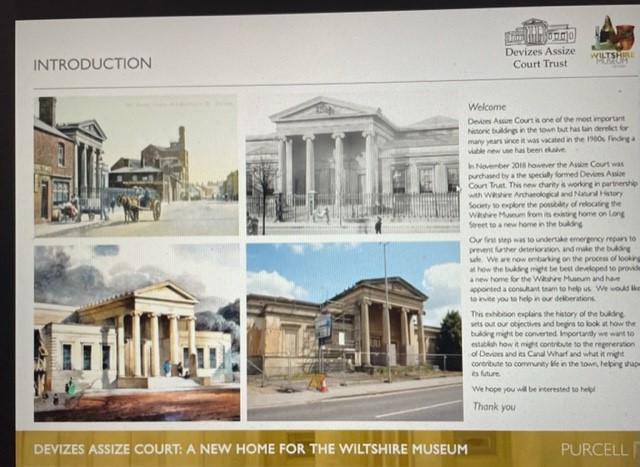
The slides that follow are ones used in the video and on the hoardings outside the Assize Court during the consultation. One of the interesting aspects of the building is that it has the canal behind it, it might be possible to use the rear of the building overlooking the canal as a way in. Along with image makers, they have created visualisations of how spaces will work, and how to use the spaces outside to engage with people.

In this slide, you can see where the canal is situated in relation to the building which is a real asset; water being a great feature in any situation. Think of the Hepworth in Wakefield and how fabulous it is to see the river snaking around the building.

The next slide looks at the audience development report where people were asked if they visited the current museum and what would influence their decision to visit. Telling stories of Wiltshire came out very strongly, and providing interesting things for the children to see, for example leaving cells in the basement. Location and layout of the present museum is seen fairly obviously as a problem, which I feel has been largely overcome by a determination to make things happen.
This slide looks at the potential audience for Wiltshire Museum
This slide below gives an idea of how people feel about the current museum which engages with about 20,500 people annually, it's seen in a very positive light as can be seen by the words people used to describe how they felt
This slide which you can only see if you home in, asks questions about why people don't visit, and the reasons they give.
The next one asks why people do visit.
The next slide shows that twice as many people use the building as visit it. The shop is excellent and a great place to buy cards, books and other items.
You may have visited the recent Ravilious exhibition, I visited it twice and thought it was fabulous. The Duchess of Cornwall visited and looks very happy being shown round by David Dawson. If you click on the link, you will find the duchess also visited the new cinema in Marlborough.
This slide was also very interesting, the figures are amazing and well deserved. If you put on exhibitions and advertise them, people will come, and spend money in Devizes town as well as in the museum. A calculation was made that it was worth £500k to the town in extra revenue. People eat and shop when they visit the exhibition.
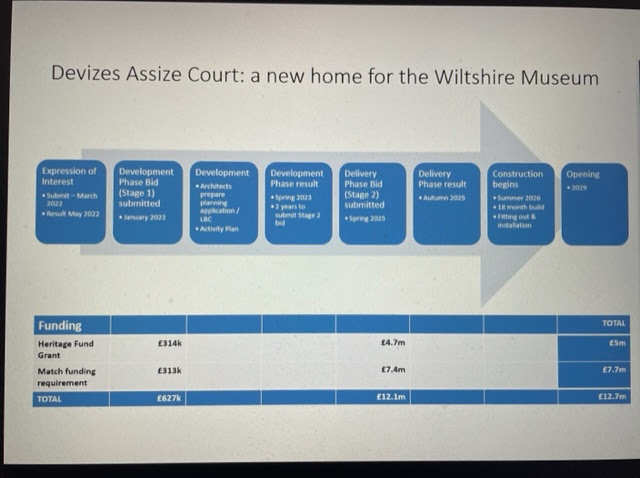
Below a timeline and costings
And what's coming up
Including Hardy's Wessex which opens on 28th of May and is part of an exhibition in 4 museums.
Lots of food for thought in the talk. We will follow the progress made towards a new museum for Devizes with interest, and wish David Dawson every success in moving this project forwards.


Sunday, 21 November 2021

Visit to Wiltshire Museum, Devizes

 Twelve members of the Friends met at Wiltshire Museum in Devizes last week to have a look at the Ravilious exhibition curated by James Russell. I thought I'd start with a photo of our group since it is such a rare event to get so many of us together in person. On arrival, we were offered a drink and biscuits in this room before going to look at the exhibition, we could also leave belongings in there for a couple of hours, which was very handy.

I'll also include a copy of the poster because there was no permission to take photos of the Ravilious works. 

It is a wonderful exhibition with many paintings and works by Ravilious, it's well worth seeing, not to be missed I would say. The rooms where the works are shown have been upgraded and are really lovely as well. I took a few photos of the wonderful museum artefacts, there are a huge amount of exhibits there.

I took 2 photographs of the Britton 'Celtic' Cabinet which was made in 1824 it's made in the shape of one of the trilithons at Stonehenge with inset watercolours by contemporary artists such as Cotman, it's well worth looking up when you're there.

There are many examples of storage jars, this pear shaped one was particularly lovely, it was found at Crofton.

Above are inlaid and glazed floor tiles found at Nash Hill tile kiln and Malmesbury Abbey 1275-1325

There was also an exhibition of 6 of David Inshaw's North Wiltshire Landscapes coloured etchings and aquatints which are fabulous, but hard to see on a stair way and difficult to photograph because of reflections. I have found information about them online and therefore have one good photograph:

This one is called 'Silbury Sunset'
Above Marlborough Downs
That one is 'East Kennet'

Above 'Silbury Sunrise;
This is what the Art Fund website says about them:

These vivid coloured aquatints are the first works that he produced in this technique. Those depicting the prehistoric monuments in the Avebury World Heritage Site point to the tradition of British Romanticism, of hallowed ancient monuments depicted in their landscape setting. Inshaw admired the work of Thomas Hardy and, like Hardy, is sensitive to the physical and spiritual idiosyncracies of the region's landscape, whether in association with human figures, with the dramatic prehistoric monuments of the area, or with its native wildlife. No aspect is wholly identifiable but the spirit of the place rings out.'

Fabulous visit, thank you to all who make Wiltshire Museum in Devizes such a brilliant place tfor visitors..

Thursday, 28 October 2021

Ravilious: Downland Man a talk by David Dawson

 We were very fortunate last night to have a talk by Director of the Wiltshire Museum in Devizes, David Dawson, about a current exhibition they are holding entitled Ravilious: Downland Man. The exhibition is curated by the fabulous James Russell, who many of you know via talks and exhibitions.

Last night we were treated to a highly illuminating talk, with many slides, particularly fascinating was some of the background information to paintings, and the fact that David had been out to photograph many of the places in Wiltshire that Ravilious had painted. It really made us feel that Ravilious had a great empathy for the chalk downlands, although he was really maybe a Sussex downland man at heart, having moved from London where he was born to Eastbourne. Ravilious went to Eastbourne School of Art and then the Royal College of Art where he met Paul Nash. He was influenced by landscape painters John Sell Cottman and Alexander Cozens.

During the talk, I took many photographs of the computer screen, hopefully these will give you an idea of the talk, it was also recorded, so you can watch a recording, the link is at the end of this post.

David started by showing us this famous photo of Ravilious at the Royal College of Art in the early 1920s, and then talked about this wood engraving below, apparently cutting out the white areas which was the reverse of what most people were doing. The piece is 3''x4'' which must have required special tools to get this sort of detail. A schoolfriend apparently lent over the back of a sofa to pose so Ravilious could achieve this position. There's a lot more detail than I had seen before in the background, including what might be a red kite on the left.


The landscape in the background as seen above was an important feature of the work, seen particularly clearly in the Morley College murals which were painted from 1928-30 with Edward Bawden. After the Royal College, Ravilious went back to Eastbourne where as a teacher he met Tirzah Garwood, and with the cheque from the Morley murals, was able to convince her father that he could provide for his daughter. Tirzah was a prolific artist, this is a wonderful example of her work, like Ravilious, she chose a train carriage and depicted a downland background including a chalk pit.

Sir Geoffrey Fry of Fry's chocolate lived at Oare House, just south of Pewsey for much of the twentieth century, he had extra wings added to the magnificent house by Clough Williams-Ellis, and commissioned Ravilious to visit and do some paintings.

The gardens are open for the NGS and well worth a visit.While there Ravilious painted in the area, including at Rainscombe, on the downs above Oare, and below you can see the painting on the right, and the photograph of the area on the left
Similarly Huish Gap in the painting and a photograph of the site where apparently there has been a boundary for 3000 years.

But the most famous painting Ravilious produced at this time must be 'Strawberry Nets' painted with the most amazing precision in Oare House garden, David showed us the exact site where the strawberry beds were, now a compost heap!

I also like this painting very much, it's painted from the first floor of Oare House overlooking the garden and the downs can be seen in the distance.

There was an interesting tale behind this painting, which like many others David has pinpointed where it was painted. This is a particular favourite of his with the marching telegraph poles and the red van, dating the time it as painted. When it came up for sale, David raised £180,000 in an attempt to buy it, however it went for £220,000 at auction, and would have needed at least 30% fees on top of that.
 
David went on to talk about Ravilious' meeting and staying with Peggy Angus at Furlongs where they both painted The Cement Pit:

This painting below called Chalk Paths demonstrates Ravilious' sparing use of watercolours to achieve the effect of chalk where the white paper shows through, he also mentioned that Ravilious was able to capture light so well in paintings, even when it changed while he was completing it.

There were Shell guides produced at this time to encourage people to buy petrol and drive around the countryside. It could have been that Ravilious wanted to be asked to produce paintings for one of the guides when he produced paintings such as the one below:

There were also illustrated books using lithography:

and Puffin commissioned artists
In 1939 Ravilious was commissioned to produce a book entitled 'White Horse, this painting was going to feature on the cover of the book, and there were various pages produced as mock ups of what the book would be like.

The war intervened and the embryonic book was lost for years, and found recently. The Wiltshire Museum bought the book in 2012 for £6000.

Many of you know that the end of the Ravilious story was sadly in Iceland in 1942 when the plane Ravilious was flying in disappeared almost with out trace. We had featured Ravilious talks by James Russell in the past, and visited the fabulous exhibition curated by him at the Dulwich Picture Gallery. Please click here for links back to those blog posts recalling the events.

I also fortunately recorded the talk, so for the real thing, please click here.

Friends will visit this exhibition on 18 September at 11.30am, but of course you can visit at any time until 30 January 2022.